On the morning of June 9th, 2008, the final two flyovers in the new $154.7 million, fully-directional interchange at US 281 and Loop 410 next to San Antonio International Airport opened, marking the end of an era in San Antonio's freeway history.
Prior to the interchange's construction, motorists wanting to go from Loop 410 to US 281 or vice-versa were left to navigate overburdened surface street and access road connections. This intersection was often cited as the only place in Texas where two major urban freeways crossed without direct connections between them. As a result, traffic frequently queued on Airport Blvd. and the westbound 410 access road as drivers negotiated their way between the freeways. Only one of the turns required no interaction with a traffic signal; all of the remaining directions required motorists to pass through at least one signalized intersection. While many people simply blamed this traffic nightmare on poor planning, the real story, as is often the case, is not that simple.
Initial plans in 1960 for the North Expressway (US 281) did not include an interchange at Loop 410. Instead, it seems planners believed the use of Airport Blvd. and San Pedro Ave. as connectors would suffice, at least initially, and streamlined interchanges with those roadways were planned. However, it appears that, by 1964, they reconsidered, and an interchange at 410 was proposed.
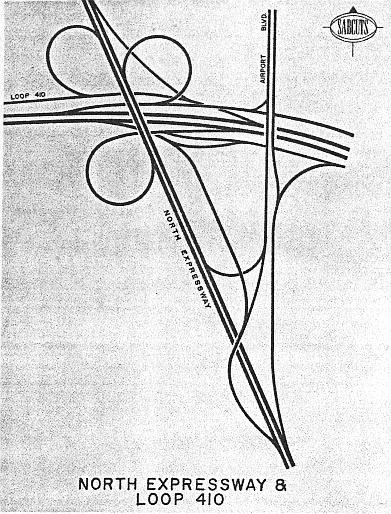
Proposed US 281/Loop 410 interchange
This conceptual diagram from the 1964 San Antonio expressway plan
shows an interchange at Loop 410 and US 281 next to the airport was considered.
Freeway battle ensues
After evaluating several routes including San Pedro, McCullough, and Broadway, a preferred route skirting Brackenridge Park, passing between Alamo Stadium and Trinity University, and heading north through a corner of the city of Olmos Park was selected. However, the City of Olmos Park objected to this plan, so an alternative route slipping between the Zoo and Alamo Stadium and continuing north over the Olmos Basin was ultimately chosen.
Not long after the planned route was announced, significant opposition emerged and lawsuits filed over the proposed alignment for the new freeway in the vicinity of Brackenridge Park. Construction on the northern and southern thirds of the freeway was allowed to start while the controversial middle section was re-evaluated and re-litigated.
Project seemingly doomed, interchange land released
Opponents of the route eventually won a federal ruling halting construction on the grounds that the freeway violated a then-new federal rule prohibiting freeways from crossing parklands. By this point, the project appeared doomed. The City of San Antonio, which was required to obtain the right-of-way for the project, was in the midst of acquiring land for the planned 410/281 interchange. With the project seemingly dead in the water, the city had no choice but to abandon the right-of-way acquisition. As a result, new buildings sprang-up at the interchange site almost overnight.
A few years later, after additional political and legal wrangling, Congress passed a law that allowed the city and state to build the freeway without federal funding and regulation. Unfortunately, by this time, the cost of the land for an interchange had become prohibitively expensive, and so the interchange was shelved. (For a more in-depth history of the US 281 drama, see my US 281 North page.)
The need for an interchange becomes critical
Initially, traffic volumes were low enough to allow relatively easy access between the freeways using access roads and adjacent surface streets. By the late '80s, however, traffic volumes began to severely overload this arrangement. To fix the problem, TxDOT began design work on a four-level interchange. Several preparatory projects in the vicinity were undertaken in the mid and late '90s including the widening 410 between McCullough and Jones-Maltsberger and the placement of most of the future ramp pylon foundations and pedestals along that stretch. The US 281 overpasses over Loop 410 were also rebuilt and a couple of strategic turnarounds added. Additionally, a flyover from northbound US 281 directly into the airport terminal area was built, although this ramp was actually proposed and funded separately by the airport and the FAA.
An interchange finally rises
After several years of uncertainty over funding, the state finally funded the entire project in late 2004. It was originally scheduled to be built in five phases over ten years. However, new funding mechanisms from the legislature allowed the phases to be combined, saving a considerable amount of time and money. That consolidated project — the largest single highway construction project ever awarded in San Antonio up to that time — was then projected to take five years to build, but the contractor promised to build it in just over three years. Work continued almost non-stop, 24 hours a day, seven days a week, and the first flyover to be completed, from 281 southbound to 410 westbound, opened to traffic on the afternoon of June 18th, 2007. Several additional flyovers opened in the months thereafter, and the final two connectors — from both directions of US 281 to eastbound Loop 410 — opened less than a year later on the morning of June 9th, 2008, marking the the end of the storied non-interchange.

