

|
||
|
|
||
This page last updated February 15, 2024 |

Road construction is a subject that generates a lot of complaints, criticisms, and Monday morning quarterbacking. Yes, construction is often inconvenient and frustrating, although sometimes it seems like many folks simply have a visceral reaction to the orange signs and barrels and perceive the amount of inconvenience and/or danger to be much more than it really is. Construction means change, and maybe it's just ingrained in human DNA to complain about change.
Regardless, as with most things, there are two sides to the story, and this topic is no exception. Believe it or not, the city, county, and state and their contractors do try to minimize the amount of disruption as much as possible, and it's in the contractor's own interest to get things done as quickly as possible so they can get paid and move on to other jobs. But some delays, inconvenience, and disarray is inevitable — that's just the nature of the beast. Remember, "no pain, no gain." Or maybe Dolly Parton said it more elegantly: "If you want the rainbow, you gotta put up with the rain."
Read on for answers and explanations to the most frequent road construction questions and complaints.
|
ADVERTISEMENT |
On this page:
That said, construction projects are very dynamic, and there are times when work sites are dormant as the result of a number of legitimate circumstances:
- Inclement weather or its after-effects. Besides the obvious effects of rain, cold weather can also delay a project as asphalt and concrete often cannot be laid or poured in cold temperatures.
- Work cannot continue until concrete or pavement has cured.
- Some elements of the project need to be complete before others, which means that some sections inherently go dormant in the meantime.
- The contractor is waiting on a delayed utility adjustment or material delivery.
- An integral piece of equipment has broken-down and is awaiting repair.
- A required crew or piece of equipment is working another section of the project or is delayed on another project.
- Something was discovered on the work site that was unexpected that requires the contractor to wait while an engineering change is designed and approved.
Another reason you might see workers standing around is that they're waiting for something else to get done before they do their part. For example, a backhoe might be digging a trench, then the workers will come in and lay some pipe, or a truck is dumping a load (or is on the way) that the workers will then come in and distribute, or a supervisor or inspector is checking something out and workers have to wait for the inspection to be completed. You only see workers for a second or two as you pass by, so you don't see the bigger picture of what's happening before and after that.
There are some people whose job often requires them to be standing around seemingly doing nothing, such as inspectors, engineers, and safety spotters, but they're still doing something productive.
Local engineer Grady from the popular YouTube channel "Practical Engineering" does a great job of explaining this subject in his video "4 Myths About Construction Debunked", which I strongly recommend watching. (The link goes directly to the section on this topic.)
As any project manager worth their salt will tell you, there are three constraints for completing any project: speed, quality, and cost. The catch is that you can only manage two, and adjusting one affects the others.
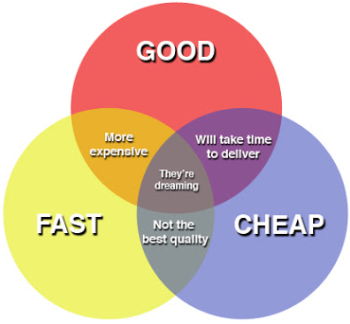
Of course, it's important for all road projects to be done well ("good"), so that leaves fast vs. cheap. Since most projects have limited funding and are by necessity low-bid ("cheap"), that means they can't be done as fast as we'd all like. To do them faster would require either (a) higher taxes/tolls, or (b) fewer needed projects getting done.
Due to funding and resource availability, as well as manageability, road work is typically done in sections. So in some cases, it may seem like a specific road has always been under construction, but in reality, different sections have been under construction and completed at different times over the course of many years, sometimes back-to-back, but often with breaks in between. Over time, however, all of that blurs together in one's memory giving the illusion of that road "always being under construction." That may make for a good — albeit trite — punchline, but it’s what happens when people expect infrastructure to remain safe, functional, and in good condition.
First of all, TxDOT, for example, is an agency of 12,000+ people, and they hire hundreds of contractors and subcontractors each with plenty of workers to build their projects. Together, they have the resources and experience to manage multiple projects at once, and contractors are quite adept at allocating equipment, crews, and subcontractors to multiple projects without impacting the progress on any of them since any delays directly affects their bottom line. Large city and county governments have similar abilities and depth.
To help understand how a contractor can juggle multiple projects, let's look at a similar example: home construction. Take a look at a new subdivision being built — does the home builder only build one house at a time? Rarely. Instead, they're working on multiple homes at once, each typically in a different phase of construction, and making progress on all of them simultaneously. They pour the foundation for the first house, then the framing crew comes in while the foundation crew moves on to the next house. When the first house is framed, the electrical and plumbing crews come in while the framing crew moves to the second house and the foundation crew starts working on the third house. Then the Sheetrock team comes in to work on the first house, the plumbing and electrical crew moves to the second house, the framing team moves to the third house, and the foundation team starts the fourth house. And so on. And this entire process is occurring at the same time in another nearby subdivision with a different home builder. Road construction uses a similar process with multiple contractors working the different projects, with grading, drilling, concrete work, paving, and finishing work being some of the major phases that can be worked simultaneously across different projects.
Even with those resources, road construction just takes time for the reasons explained under "Why does construction take so long?" above. So even if the city/county/TxDOT and their contractor only worked one project at a time, it would still take about the same amount of time to complete that project.
That aside, let's look at the question on its face: If road construction was done one project at a time, it would take even longer to get things done. First of all, how would you determine the constraints for your one project? Would it be a specific road, an arbitrary section of the city or county, a whole city or county, a region of the state, the whole state...? For argument's sake, let's say it's by county. In Bexar County in mid 2024, there were 78 TxDOT projects underway with an average duration about 1.75 years each. So, if each project were worked one at a time, it would take over 136 years to complete all of those projects that, when worked simultaneously, will all be done in just a few years. And that doesn't include the projects done by the county and various cities — would their projects have to wait when TxDOT had one underway and vice versa? There is simply no way to ever get all the needed safety, congestion, and maintenance improvements done on that kind of schedule. On top of all that, construction costs typically increase every year, so waiting to build projects just increases their cost and means people would have to wait even longer for congestion relief, safety improvements, or even basic maintenance.
Hopefully at this point, you can see the idea of waiting until one project is finished before another starts is absurd, but if not, you can take heart: there are enough projects underway at any one time that, when one project is starting up, another project somewhere is wrapping up.
First of all, there are lots of contractors that do road work, so not every project is done by the same contractor. Each contractor has their own crews and often uses subcontractors, so there's not just one construction crew for everything. While most contractors work multiple jobs and do usually shift workers around those various jobs as needed (see the home construction analogy in the previous question), for the most part, they try to schedule their crews and subcontractors so that all of their projects are worked on in some form nearly continuously. To be sure, there may be cases where a needed crew may be delayed on one project and not be immediately available for another when that project is ready for them. When this happens, a contractor will often then try to do some other items on that project out-of-sequence with the crews they do have available if they can in order to keep the project progressing. It's actually in the contractor's financial interest to do so, not only to avoid delays that may result in penalties (see below), but also because they want to get the job completed so they can get paid and move their crews and equipment on to the next paying job.
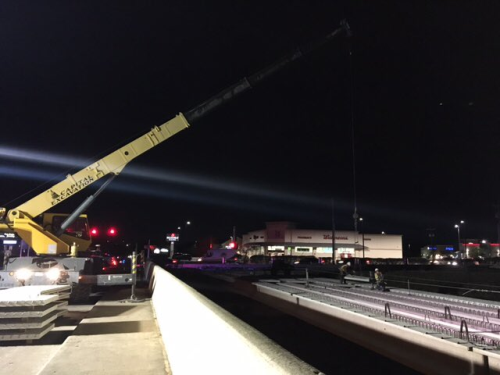
However, the reason is quite simple: manholes, storm drains, driveway aprons, and so forth are all built to the planned level of the final road surface. However, that final layer of pavement (usually a few inches worth) is not laid down until the very end of the project. Therefore, when a road is still under construction but open to traffic, there will be an offset between the temporary road surface and those other structures.
So why not lay down the final layer of pavement before letting traffic use the road? Essentially, it's the same reason why you don't put down carpet or flooring in a house that's still being built — you don't want it to be damaged by the ongoing work. Also, the subsurface layers of pavement can settle and/or deform a bit after being laid, so it makes for a better final product to wait a while before applying to top layer. That allows the top layer to smooth-out any imperfections that develop in the lower layers during curing.
So why not install the manholes and other structures at the lower level and raise them up during final paving? This is certainly possible, but would be expensive to do, especially given the relatively short amount of time between inital and final paving. It would be like putting a roof over the first story of a planned two-story house, then moving it to the top of the second story when it's built. Pretty dumb, huh?
For the record, this is not something that's only done in Texas. This is the practice pretty much everywhere in the US and even overseas (I've personally seen it in Germany and England.) In short, it's just how it's done. However, they typically try to minimize the danger and annoyance by building small asphalt ramps around these hazards to reduce the potential impact of hitting one. In the end, though, it's the driver's responsibility to avoid these hazards by being careful and observant and slowing down.
Other sites of interest
 |
TxDOT San Antonio "Go Ahead!" - What’s the Hold-Up? Why the Best-Laid Plans Often Go Astray https://txdotsanantonio.blogspot.com/ |